Britain’s most extreme cleaner has made millions taking jobs ‘no-one else will do’, including dealing with murder scenes, hoarders’ homes… and the carcass of a 22-metre whale
Britain’s most extreme cleaner has made millions taking jobs ‘no-one else will do’, including dealing with murder scenes, hoarders’ homes… and the carcass of a 22-metre whale
The man dubbed ‘Britain’s most extreme cleaner’, whose extraordinary career has seen him step into scenarios that most people would run 100 miles from – including brutal murder scenes, decaying hoarders’ homes and the aftermath of tragic accidents, says he’s emerged remarkably unscathed by the horrors he’s dealt with.
Speaking to the Daily Mail, Ben Giles, 49, who lives in Cardigan, Wales, thinks growing up on his parents’ farm helped steel him early on for the jobs he’s been asked to attend as the country’s leading bio-hazard cleaning expert.
In a 25-year career that has seen him routinely picking up body parts and dealing with every bodily fluid, from solidified phlegm and semen to spilled blood and urine, Giles says he’s rarely been deeply affected by the traumas he’s seen, putting it down to a naturally strong constitution and talking his day through with his wife.
His cast-iron stomach and niche work has made him very rich; he sold the company, Ultima, which he founded in 2000 several years ago to cleaning giant Atlas FM, which has a 14,000-strong workforce and is worth £350million. Giles remains very much on board though, offering consultation and occasionally still being dispatched to jobs that need his expertise in person.
The extreme cleaner maintains he’s the lucky one in many scenarios, saying he often thanks his lucky stars that he doesn’t always know what’s happened in the rooms he’s called into, and that the emergency services carry a much bigger burden.
‘You see the pressure everyone’s under, dealing with people who are passing away, and dealing with their families on the spot.
‘That kind of pressure doesn’t exist in the world I’m in, all of the horrendous stuff has already happened.’
While he’s always one step removed from tragedy, he’s also extremely close to it. ‘You’re in one room cleaning up, and you can hear people crying in the room next door with family liaison officers.’

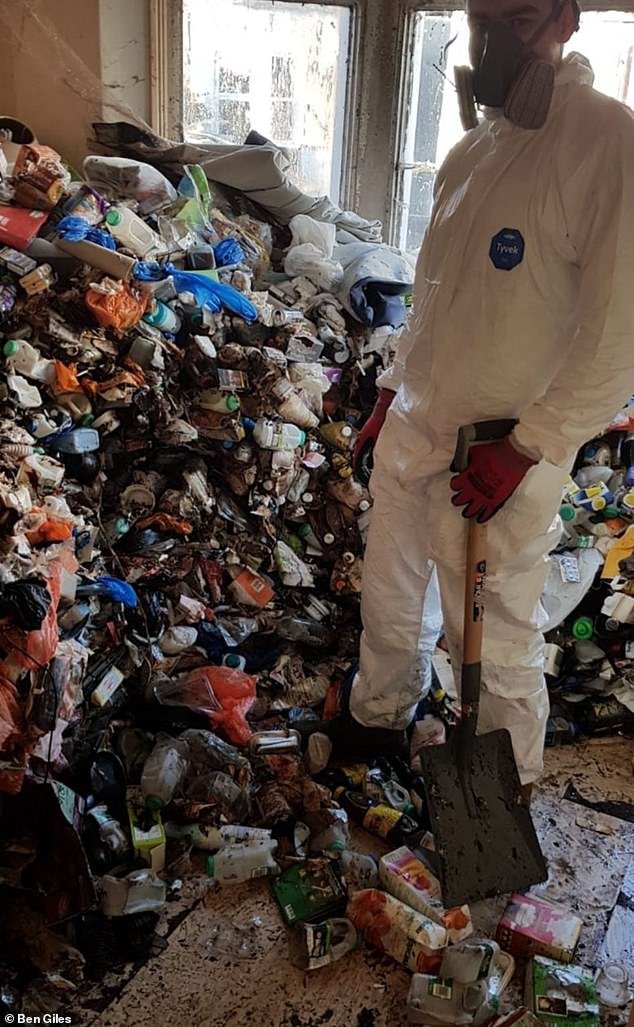
Ben Giles, who founded his extreme cleaning company, Ultima, in 2000, realised early on there was serious money to be made from saying yes to jobs other cleaners wouldn’t consider are the grounds they were too gruesome (Pictured: Sorting through piles of rubbish inside a hoarders’ house)

Raised on a farm, Giles, 49, from Cardigan in Wales, realised early on in his career that he had the stomach needed to deal with the most difficult situations, including the aftermath of murders and suicides
There is only one major ‘trauma scene’ that Giles attended that he says left such a big impression he couldn’t speak about it when the clean-up was done.
‘Early on, there was a situation where a man bludgeoned his wife to death. As a married man, I couldn’t come to terms with that. I struggled with somebody crossing that line.
‘I came home and I couldn’t talk to my wife about it, because it was so violent. There was literally blood everywhere. We had to take drawers out of the kitchen, because the blood had gone through the tiny cracks between the drawers. It was horrendous, just such a waste of life.
Giles’ journey began, like most cleaners, after he began saying yes to odd jobs as a teenager.
Realising he was a ‘grafter’ while cleaning his parents holiday rentals, he then progressed to windows, charging 50p a pane. Lightning quick, he was making more money than most of his teachers at the time, he says.
One job, though, changed everything, putting him on a very unique career path. A desperate call came in from Age Concern in Aberystwyth about a warden-assisted flat where the bath was full of urine and faeces and the floor was ‘moving with fleas’.
He took two employees with him to tackle the job, but one was made immediately nauseous at the foul stench when they opened the door.
‘One of the lads had puked up, so we chucked him in the van, took his mask off him, cleaned up his sick and then he just sat in there all day, because he obviously couldn’t do it.’

One of Ultima Cleaning’s call-outs saw them wipe down a bathroom filled with blood and dirt

Therapy: Giles, who’s a Jehovah’s witness, pictured with his wife, Linz; he says only one scenario has been so bad it left him unable to speak to her about it; when a husband had bludgeoned to death his partner in a rage
His other co-worker was more stoic, aware that he could command more money for such work.
‘He started on the kitchen, and about ten minutes in, he walks in and says: “How much am I getting paid for this? I’m not doing it for less than 300 quid.”
‘He was normally on £100-a-day or something so it trebled his wage.’
For Giles, his first adventure in bio-hazard cleaning was a breeze. ‘I found it really easy, to be honest with you. I’d grown up on a farm with dead animals and all the kind of stuff that goes along with farming, and it wasn’t really an issue for me.’
He eventually charged the warden £2,000 but said she was ‘incredibly’ happy with that price, because the neighbouring flats had also been empty ‘because of the smell’.
It uncorked a career that has seen Giles deal with every worst case cleaning scenario you can think of, entrusted by the police and training up to 500 others a year on how to deal with trauma cleaning and biohazard sites.
What’s the wackiest thing he’s ever dealt with? A decomposing 22-metre long whale that had been struck by a cargo vessel and brought into Portsmouth Harbour in 2019.
He didn’t leave Wales but he did advise from afar, as the deceased mammal was carefully diced up for disposal.

In 2019, Giles was asked what he’d do with a deceased 20-tonne whale that had been brought into Portsmouth harbour – he advised on how to dispose of the mammal from his home in Wales


Danger money? The extreme cleaner says he’s compromised his health many times while working, including picking needles up at a drug site and entering buildings that he wasn’t sure were structurally sound
His health has been in danger ‘many times’ particularly in the early days when adequate safety equipment was rare – he’s done needle picks where drug addicts have been injecting around him.
He admits: ‘We learned by mistake, which could have been tragic, but thankfully it wasn’t.’
Giles has since worked with manufacturers to produce Personal Protective Equipment that includes a mask so effective it can prevent even the most intoxicating odours from penetrating – he’s essentially become the Mrs Hinch of the extreme clean.
As a young man, Giles didn’t look too much beyond the big financial recompense of taking on work others wouldn’t do – but the decades have seen the role evolve and there’s an unlikely element of job satisfaction in what he’s achieved.
He helps reunite bereaved families with the treasured possessions of loved ones lost to tragic circumstance, removing blood stains from clothes and even repairing a shattered bike helmet so it could sit atop the coffin of a man killed in a motorcycle accident.
Giles’ faith – he’s a Jehovah’s Witness – helps in two ways, he says. ‘It allows me to have a hope, which I think is really important in this world, especially for the stuff we see. Secondly, my faith has made my family incredibly stable.
‘So, the whole ethos of my faith is just to try to be good people, to try and live by a moral code and standards to be a better person, to be a kinder person. This community has really strong families.’
When it comes to dealing with the public, there are different types of impact that the work that he does has.

A pool of blood following a loss of life; Giles says he appreciates that he’s on the scene after the trauma has happened, praising the work of first responders who aren’t shielded
‘Sometimes it’s just financial, they can now sell a property. If it‘s a parent whose child has taken their life, or someone who’s died violently in a property, or in a vehicle, there’s satisfaction in knowing that you’ve given property back to them in a state that they can now deal with and hopefully have some closure.
‘Often, they’d not even thought of the opportunity of receiving it back, or being able to see it again in a condition that was acceptable to them.’
His unusual career has rewarded him handsomely financially; he now has an Italian restaurant – his mother’s family is from Tuscany – and Giles has bought himself a herd of Highland cows.
He says: ‘Going out into the field on a nice day, and just taking a comb, and combing these cattle down, it’s just lovely. They’re a really, really placid animal, so it’s nice, I enjoy that.’
Giles doesn’t hold back on how he thinks society views cleaners in general, saying the often silent workforce can feel like they’re at ‘the bottom of the food chain’.
‘I never mind grafting, and I think all cleaners are the same, but the financial side of it at that level is just not sustainable for anybody.’
He’s trained thousands of people to become experts in more specialised cleaning, and Atlas FM now uses those people for ‘reactive’ situations.
‘Atlas FM has massive clients and every day somebody falls and there’s some blood, or someone has a heart attack. There’s loads of internal work which is nearly always reactive.
‘We use our network of trained people to go and do that work, so we kind of sub that work out to them. And that’s been so rewarding to be able to support them.
‘We train people, upskill them and keep them busy with work. So we’ve probably passed over, I would say in the last 10 years, probably close to £20 million worth of work.’
Requests to share his specialist knowledge have come from overseas too, but he says different countries have different regulations so it doesn’t always work.
An invite came from his counterparts in the US too, which he pondered, before turning it down.
‘I watched a documentary on them, and the way that they behaved, I just thought it was so unprofessional. It was very, very American, and very kind of ‘yee-ha’. That wasn’t the way I wanted to behave, it wasn’t me at all.’
His son’s illness, he was diagnosed with stage 4 cancer aged 17, gave him a new perspective on both his job and the people behind the situations he deals with.
‘It was kind of an emotional rollercoaster, and it gave me a load of empathy for people who have been through or are going through it.
His son, now 24, is well again but the family’s encounter with serious illness was a leveller.
‘Sometimes it’s really lovely just to kind of take stock of what you’ve got. You realize that the older you get, the more you don’t chase the dollar so much, you don’t have to.
Ben Giles’ book, The Life of a Crime Scene Cleaner, is out now on Amazon. For more details on his work, visit bengiles.co.uk
Source link

Latest news, essential insights and practical guides to life in Italy from The Local, Europe's leading independent voice