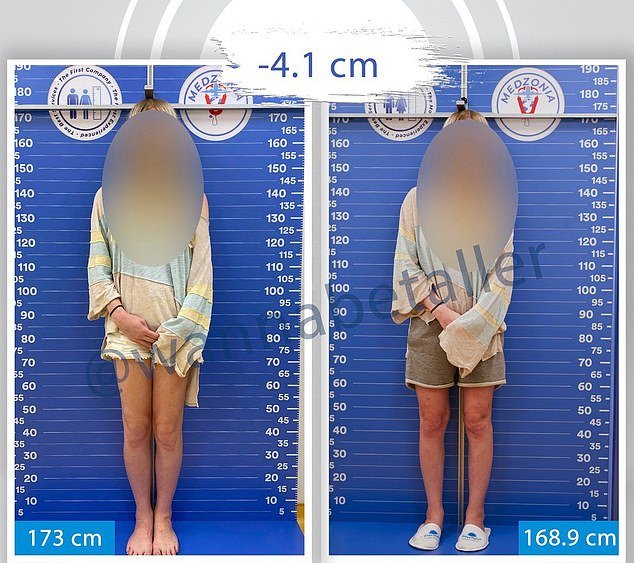
Amber hated being taller than her friends so went to Turkey for leg SHORTENING surgery. Now she tells the truth of four-hour ‘height reduction’ op – and why so many women are getting it done
Amber hated being taller than her friends so went to Turkey for leg SHORTENING surgery. Now she tells the truth of four-hour ‘height reduction’ op – and why so many women are getting it done
From her early teens onwards, Amber Berrington* was acutely conscious of her height. While not unusually tall, at 173cm (5ft 8in) she felt she towered over her classmates.
‘I always felt like I stood out, and not in a good way,’ the 30-year-old dental technician recalls. ‘I just desperately wanted to be average size, like the rest of my friends.’
That sentiment grew year on year, compounded by the sense that while heels and insoles can help people feel taller, in her case there were – literally – no short cuts.
‘I felt I had to resign myself to forever feeling unhappy about my height,’ she says.
That is, until three years ago, when an internet search brought up a Turkish clinic that offered ‘height reduction’ surgery. It is not for the faint-hearted: the gruelling three to four-hour procedure involves the femur, in the upper leg, being broken in two places and a chunk of bone up to 6cm long being removed. The severed bones are then rejoined and fixed in place with a metal rod. It can take months to regain normal mobility.
Undeterred, Amber flew to Istanbul in July 2023, emerging from her surgery just over 4cm (nearly 2in) shorter.
‘I know for a lot of people it seems incredibly extreme,’ she says. ‘But my height was something that shaped my entire life. Now I don’t think about it at all, and that’s all I wanted.’

Amber Berrington had just over 4cm taken off her height
Amber is one of ten patients – including a young woman from the UK – to have had leg shortening surgery for cosmetic purposes at Height Reduction, set up in 2023 by businessman and counsellor Ibrahim Algan.
Seven years earlier, he established another clinic, Wanna Be Taller, to provide leg lengthening surgery, which now performs around 80 operations a year on clients from all over the world, a quarter of them women.
After fielding enquiries from those wanting to lose height, Algan – himself a veteran of two leg lengthening operations, in 2015 and 2020, taking him from 160cm (5ft 3in) to 170cm (5ft 7in) – decided to offer the alternative, and opened what he believes is the first dedicated centre for cosmetic shortening.
‘As someone who underwent limb lengthening myself, it still feels surreal that we founded the world’s first dedicated leg shortening centre,’ he told the Daily Mail this week.
‘It wasn’t planned; when we first received requests we ignored them, because it had never been done before. But as requests grew, we decided to try, and interest is growing quickly. As with lengthening, it takes time for things to become mainstream.’
Certainly, leg lengthening surgery has become far more common in recent years. It was pioneered in the 1950s by Gavriil Ilizarov, a Soviet doctor treating injured soldiers returning from the Second World War.
Improvements in technology – coupled with a changing world in which ever more value is placed on appearance – have seen the surgery become employed increasingly for cosmetic purposes.
‘Advances in surgical technology have made the process safer and more comfortable, which makes it more attractive,’ says Algan.
‘And social standards are shifting: in a world of social media, physical appearance matters more than ever.’
A sizeable number of his female leg lengthening clients have migrated to the West from Asia, where they feel their relatively diminutive stature makes them stand out – although his most recent patient is a British woman.
‘What they all have in common is they want to fit in,’ he says.
That resonates with Amber, who says she had felt permanently self-conscious about being several centimetres taller than her peers since her early teens.
‘While there may be an allure to being taller for modelling, I associated being smaller with being petite and cute,’ she says. ‘Being less tall became a focus on how I could feel better about myself.’

Ibrahim Algan set up Height Reduction in 2023, where Amber had her surgery

Gavriil Ilizarov pioneered leg lengthening surgery in the 1950s while treating injured soldiers returning from the Second World War
Yet Amber did not dream there would be a solution until, three years ago, she came across an internet advert for leg lengthening surgery – a procedure she wasn’t aware existed.
‘I thought: Well, if they can do that, why wouldn’t they be able to do it in reverse, because both procedures involve breaking the bone,’ she says. ‘It seemed like common sense.’
On paper perhaps, but further research revealed that, while some renowned medical centres offer corrective surgery for those with limbs of different lengths – meaning they largely operate on one leg only – Algan’s clinic was one of the few to offer the surgery for both legs.
It took Amber eight months to pluck up the courage to book her trip. She flew to Istanbul from her Florida home having confided in no one about her plans – not uncommon with those undergoing cosmetic work.
‘You don’t want to draw attention to the thing that you’re upset about,’ she says. ‘It helped that I had a weird situation where I had been in a car accident not long before my surgery was due to happen, so I told everyone I needed some downtime away from everything. That also explained away my scarring.’
She recalls being ‘excited’ for the month-long trip, which cost her around $20,000 (£15,000), including a two-week hotel stay.
Yet she admits that, despite long pre-surgery discussions with the clinic, she was not prepared for how arduous her recovery would be. Algan says shortening surgery is ‘simpler in concept’ than lengthening surgery, but that his clinic’s doctor believes it is actually more challenging.
‘The bones are broken in two different places, and the segment in between is removed from the body,’ Algan says. ‘The broken ends inside the leg are then joined together. A nail is placed inside the bone and stabilised.’
The immediate consequence for Amber following her four hours on the operating table was ‘excruciating pain’.
‘I was pretty much just completely immobile for three days and when I first used the walker they provided, it was so painful I fainted,’ she says.
‘It was a really long process for me to even get on the walker. While I did as much research as I could, I did not anticipate until I actually got there just how intensive the recovery process would be.’
Only around nine months after the surgery – and following intensive daily physiotherapy and a second surgery in the US to remove the metal rods inserted to help the bone fuse together – did Amber regain full mobility. It took around the same amount of time for the cellulite-like appearance of the skin on her thighs to go back to normal as it adjusted to the new shape of her thigh.
Astonishing though it may sound, Amber insists that no one – not her parents, friends or even her boyfriend – appears to have noticed the change in her height.
‘I don’t know whether it’s because their brains can’t compute that I can have made myself shorter, so they don’t go there,’ she says. ‘But no one has said a word.’
Nor did anyone notice when warehouse manager Andreas Lundqvist*, 33, from the Swedish capital Stockholm, returned home after a trip two years ago 4.8cm shorter than the 196cm (just under 6ft 6in) he was before.

Andreas Lundqvist’s surgery took his height from 196cm to 191.2cm

‘I don’t know whether it’s because their brains can’t compute that I can have made myself shorter, so they don’t go there,’ Amber says. ‘But no one has said a word.’
‘The funny thing is that no one seems to have noticed – I’m still a tall person, and people still see me that way,’ he says.
Like Amber, Andreas had been self-conscious about his height since his teenage years, having grown very tall by his early teens.
‘I developed negative feelings around it early, to the point that it became an obsession,’ he recalls.
For many men, of course, height is seen as a status symbol – but Andreas, who admits he would generally be considered ‘handsome’, never felt that way.
‘There was nothing wrong with me, really, but I guess I grew a little obsessed with the idea I was little bit too tall,’ he says.
‘And while intellectually I knew being tall is considered a good thing, I just could not shake off this idea that I wanted to be shorter. It was a constant internal dialogue within my own head.’
Like Amber, he never shared his feelings, but the thoughts proved so intrusive that in his early 20s he was diagnosed with body dysmorphia.
‘Part of the issue was this sense that there was nothing I could ever do about it,’ he says.
He recalls trying to find shortening surgeries around that time, only to discover there did not seem to be any legitimate clinics offering the surgery.
‘I realised that it was probably not possible, so I stopped thinking about it,’ he says. ‘And then, three years ago, I thought about it again and suddenly I found this facility in Turkey.’
In spring 2023, he flew to Istanbul for what would be a month-long stay, the cost of which he covered from savings, undeterred by the risks attached to the surgery, which can lead to permanent deformity, nerve damage and muscle weakness. ‘I was so determined and mentally prepared to do it that I was willing to go through the risk and pain,’ Andreas says.
After meeting his surgeon, Andreas decided to have more than 4cm removed from his femur.
‘He told me how much he could take before it becomes impossible to do it or your physique is just too compromised, and I chose to go for the maximum amount in my case, which was about 4cm,’ he says.
This is, as Algan explains, 2cm short of the 6cm ‘maximum’ that can be removed from the femur while retaining full functionality.
‘The taller the patient and the more flexible their muscles and nerves are, the greater the amount of shortening that can be performed,’ he says.
‘Being young, healthy and fit also helps.’
Even so, Andreas describes the first week after his successful operation as ‘horrible’.
‘I was mentally prepared for it, but it was still tough,’ he says. ‘I would say I’m still in the recovery process now, and it’s been two years. I’m not sure I will ever be the same as I was in terms of athletic ability.’
Nonetheless, he believes that the gruelling surgery was worth it to remove the angst that dogged him before.
‘I’m less self-conscious and more content with my height now,’ he says. ‘I don’t regret it, because it alleviated my negative feelings to such a degree that it made it worth it.
‘But I think people have to think long and hard before they go down this road.’
That’s a sentiment shared by orthopaedic surgeon Dr Kevin Debiparshad, who has latterly also noticed an increase in inquiries for leg shortening surgery at his LimbplastX Institute in Las Vegas.
Considered a world expert in lengthening surgery both for trauma and cosmetic cases, he now performs five or six shortening operations a year as opposed to just one or two when the clinic opened nine years ago.
By contrast, he performs around 50 lengthening surgeries a month, around a fifth of them cosmetic, although he believes that will change with the imminent release of a new ‘weight-bearing’ nail – used to connect the broken bones – which will allow his leg lengthening patients to return to full mobility within days of surgery as opposed to weeks.
‘That’s a game changer,’ Dr Debiparshad says.
‘Cosmetic is already the fastest growing sector in the limb lengthening market and I think a decade from now it will be the biggest slice of the pie, over things like trauma, paediatrics and corrective surgery.’
He is more cautious about predictions for shortening surgery, which he views as ‘much harder’ and less forgiving.
‘You have to be very careful with how much you decide to shorten,’ he says, ‘because if you take away too much bone, you weaken the lever on the muscles and, while they can cope with that to a degree, if you weaken them too much, they may have a lot more difficulty mobilising.
‘I would say 6cm (2.4in) is the maximum that can be taken, although it is all relative to your height. I am always very clear that this is not an easy surgery.’
Nonetheless, the inquiries still come in from all over the world. ‘Where I see the growth is in the transgender population, particularly trans women, who feel their height stands in the way of what they want to look like,’ Dr Debiparshad says.
However, he said he recently performed the surgery on a American woman who was 190cm tall (6ft 3in). ‘It can make a huge difference psychologically,’ he adds.
As Ibrahim Algan points out, people generally want to be taller rather than shorter.
‘Being tall has many well-known benefits, whereas the desire to be shorter is quite rare and still seen as a surprising thing to want,’ he says.
‘At the same time, people are only just beginning to learn this surgery exists so I think we will soon better understand how much demand there really is.’
Over in Florida, Amber says she would stop short of recommending it.
‘I’m definitely happier I’m shorter,’ she says. ‘But when I think about the expense and the length of the recovery, I’m not sure, given the choice, that I would do it again.’
*Names have been changed to protect identities.
Source link

Latest news, essential insights and practical guides to life in Italy from The Local, Europe's leading independent voice